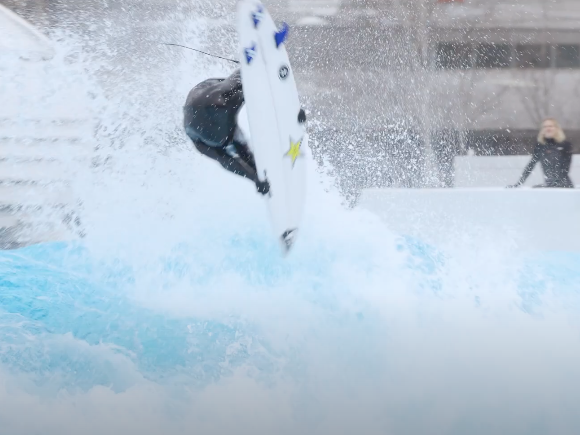
Surfing in the middle of Berlin
In the Lichtenberg district, in the east of the city; among vestiges of the Stasi and near the Vietnamese quarter, is Wellenwerk, the wave factory
Text and photos: Ricardo Ginés
In the heart of Berlin, you might spot people carrying surfboards on the tram. This is because the iconic East Berlin neighborhood of Lichtenberg is home to the Wellenwerk sports center (literally, wave factory), where you can surf right in the middle of the city.
If you see one of them, you can be sure you're looking at a regular at Wellenwerk, someone who's brought their board from home to surf for an hour in the "landlocked" east of the city—the term surfers use for being unable to access the sea. Germany's most traditional surfing spot is also located in a large city far from the sea: Munich, where until recently you could surf the Eisbach stream.
With the arrival of Wellenwerk in Berlin in 2019, one of the largest artificial waves in Europe arrived, reaching up to 165 centimeters. It is advertised as "the only indoor surf arena."
There are quite a few here, the demand is high, surfers who for 49 Euros sign up for an hour of surfing before going to work.
For beginners, it's a bit more expensive (59 Euros) since they are first monitored and prepared with lessons. Until they get used to the waves, they hold onto a bar.


Those who come here often have a generous salary because not everyone can set aside 300 euros a month to be able to surf for about six hours like many do here.
“The high prices are due to electricity consumption. That’s why it’s so expensive. Unfortunately, it’s not very profitable (especially since the war in Ukraine),” observes Malte Bergengrün, the handyman at Wellenwerk. Malte is a carpenter by trade and, among other things, he also designs and repairs surfboards.
What immediately strikes you upon entering the pool area is the high ambient temperature (almost 30 degrees Celsius). The water is also warm, at around 26 degrees. The explanation lies in the operating system: “It basically consists of pumps that draw water from below so that it flows upwards. These pumps naturally produce waste heat. We use this waste heat to heat the entire building, the water, the residential building (we have a house there), and the office building across the street. So we try to harness this excess heat—essentially waste—to save energy in other uses.” The result is a continuous cycle.
“And that’s how we can produce an infinite wave,” Malte adds.
Lichtenberg, a neighborhood closely linked to history and politics
Very close to the Wellenwerk is the epicenter of Berlin's Vietnamese life: the Don Xuang Center, literally the grass of spring.
It's a huge, 163-hectare complex dominated by shops and restaurants, functioning as a kind of parallel universe to the city, a mini-Hanoi. The majority of the merchants here (65%) are Vietnamese, though you'll also find Pakistanis, Indians, Chinese, and Poles.
Officially, around 30.000 people of Vietnamese nationality live in Berlin. And it's not surprising that an eastern district has a large population of Vietnamese origin, from a communist country: most of their ancestors arrived in East Germany as "Vertragsarbeiter" (contract workers).
Interestingly, another enormous complex in Lichtenberg, comprising 50 buildings filled with hundreds of offices, is also linked to the history of a country that no longer exists. This is the former headquarters of the Stasi, the Ministry for State Security. In 1989, the Stasi employed 90 officials and some 180 informants. Within this same center of fear, then tightly sealed off from outsiders, there was a supermarket, a bookstore, a travel agency, and even a barbershop exclusively for officials. Now, it has all been transformed into, among other facilities, a museum dedicated to the memory of that intelligence and secret police force. At its heart is the question of how the SED party managed to control millions of people in the GDR for 40 years, a theme vividly portrayed in the film "The Lives of Others" (Florian Henckel, 2006).
Erich Mielke's office, the head of the Stasi when the Berlin Wall fell in 1989, is still preserved here, very close to the Magdalenenstrasse metro station (which is why "Magdalena" was synonymous with political persecution in East Germany). Also located here is a vast archive of the same intelligence agency, containing 111 kilometers of files. Nearby is the headquarters of Astak, the Anti-Stalinist Action.
Outside, an open-air exhibition about the “revolution and fall of the wall.” This very spot is iconic for the “peaceful revolution” in East Berlin: it was stormed on January 15, 1990, by thousands of Berliners shouting “Never again Stasi” to stop the destruction of the Stasi records.
Today, citizens can check in the archives if a file has been found in their name, and a lot of time and patience is spent converting thousands of shredded, destroyed records into accessible documents.
And even larger than all these buildings put together is Lichtenberg's Tierpark, the 160-hectare zoo created by communist Germany as a response to the West's Zoologischer Garten.
This park is home to some 7.800 animals of 632 species, including the recently added Sayan snow leopard, with its decidedly unsettling gaze. Interestingly, the bronze used for the animal figures in the park comes from a five-meter-high statue of Stalin erected in 1951 and removed ten years later.
Also very political is the Friedrichsfelde cemetery in Lichtenberg, known as the "monument to the socialists".
Here lie the remains of celebrated communists such as the murdered Karl Liebknecht and Rosa Luxemburg. When they were taken to the cemetery on January 25, 1919, some one hundred thousand people accompanied the coffins, forming part of the enormous funeral procession. Incidentally, Luxemburg's coffin was empty, as she was presumed dead, but her body had not yet been found. A few months later, it was discovered in the Landwehr Canal. Curiously, the cemetery featured a monument to the revolution by the architect Mies van der Rohe. Although it was destroyed by the Nazis, van der Rohe, by then in exile, had to defend himself in 1957 before McCarthy's anti-communist tribunal. The then septuagenarian did not disavow his "revolutionary work."
And the intertwining of politics and history extends to another place in Lichtenberg: Karlhorst, where the unconditional German surrender was signed on the night of May 8-9, 1945, and where several buildings were subsequently occupied by Soviet intelligence, now run by artists. The site of the signing was, until recently, the Russian-German Museum, now simply the Karlhorst Berlin Museum.
Even after the fall of the Berlin Wall (1989), Lichtenberg returned to the political headlines when a house at 122 Weitling Street was occupied in June 1990 by armed neo-Nazis. This was the first occupation by the far right, a landmark event that was a response to the Nationale Alternative, the first neo-Nazi party created in the then-existing GDR. Soon the district became known for its strong presence of neo-Nazis from both East and West.
Today there are still some traces of a neo-Nazi presence in Lichtenberg, but a tattoo parlor that was central to the movement has already had to close its doors.
The Wellenwerk, or the wave factory, where any kind of discrimination, including racist discrimination, is clearly prohibited, demonstrates how much the neighborhood has changed in recent years.

Special coverage of the Paris 2024 Olympic Games on DUKE is presented by:










Related Notes:

The day the big rider from the middle of the field came to surf in Nazaré
Pepe Gómez learned to slide five years ago, he lives far from the sea, works in the meadow and yesterday he got off that bomb that you see in the photo


Tahiti is surfing again
After 48 days with the beaches closed, Jeremy Flores celebrated: “It's so good to see you again, thank you Mother Nature,” he wrote on social media

Let Mar del Plata go surfing
On the importance of surfing in the happy and the nonsense of not allowing it there


Clay Marzo and the art of surfing differently
On a perfect right somewhere on some island in the Hawaiian archipelago
Brazilian media points to Medina's return to Teahupoo
He will be in Saquarema for commitments with his sponsors but not competing, according to AOS Mídia.