
The Canarian cocktail
The recipe for success of the new generation of island surfers like Lucía Machado, Melania Suárez and Julia González
By Carlos Serrano
It is eight o'clock on a Friday morning in July in Salinas, Asturias. The competitors approach the tents where judges, speakers and other members of the staff They are busy getting everything ready for the championship that is about to start. The participants are talking about their upcoming heats. The smell of wet lycra and neoprene is there. “I got two Canarians: that, with the waves that there are, is pretty good.” After hearing these words, I take a quick look at the sea: it breaks half a metre with little force, slow and regretful, as if the waves never wanted to die against the sand. With my hands in my pockets, I watch Julia González, a teenager from the Canary Islands, use the little that is left of her paraffin wax to make sure that not a single spot is left unwaxed. She, like so many other islanders, is ready to go against the stereotypes. Like every summer. Like all my life.
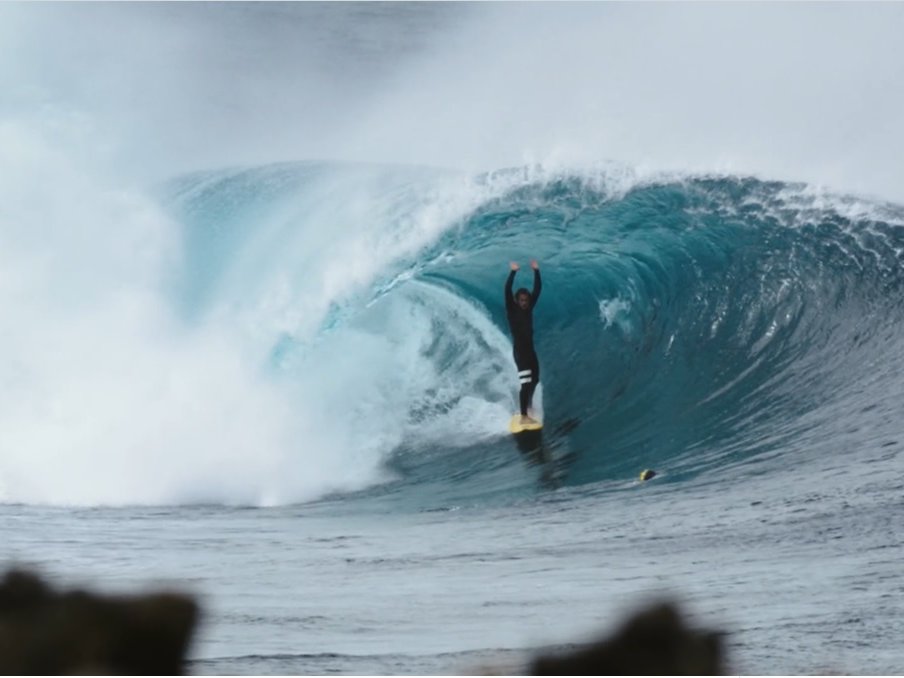
The Canary Islands have long since established themselves as a breeding ground for renowned surfers thanks to the results and prestige of competitors such as Jonathan González and Adelina Taylor. Their privileged geographical position makes the Canary Islands the “European Hawaii”: the waves, the heat and the long, calm days guarantee almost daily surf sessions for an extensive surfing community that can be seen and noticed in most of the “peaks” of the archipelago. In the Canary Islands, grandparents, parents and children surf in greater numbers than on the Peninsula; I have never seen so many children in the water as on the beaches of Gran Canaria and Tenerife. Children who, after leaving school, find an ideal playground among the slabs of volcanic rock: the hits against the bottom and the tubes are part of the initiation training of the island's promising surfers. And having such an excellent training camp means results, like those of a generation of Canarian women led by Lucía Machado (14), Melania Suárez (16) and Julia González (17), members of the Spanish team that participated in the “ISA World Junior Surfing Championship” in Huntington Beach, California, last year.
The three gather in their surfing the essence of the islands: Fast like their waves, graceful like their people and accents, strong like their volcanic landscapes. As much as the peninsular surfers point out their weakness in bad waves, the truth is that the Canary Islanders do well not to take it too seriously. They win in the same way on the white sand of Valdoviño as they do in Cicer. And also, with greater precocity: Lucía, Melania and Julia are very young, but their style and winning instinct are not. “The truth is that the competitiveness between the girls from Las Palmas, like Lucía and myself, and those from Tenerife, like Melania, has always led us to want to surf to win” says Julia González; “always from friendship, of course, but the touch of healthy 'pique' is always there”. What began as a rivalry between islands, inscribed in the DNA of Tenerife and Canary Islanders, has resulted in an extra motivation in this generation of female talents.

But the factors of the present are just as important as the backs on which the young surfers rest their feet. “Belonging to a third generation of surfers has caused the Canary Islands youth to have a much more internalized awareness of what surfing is than in the peninsula, where surfing communities and championships are much more dispersed,” says Dani García, director of the Special Surf Camp and renowned coach and competitor who is preparing Julia González for her future heats in France and Spain.
But not even Lucía's successes (sixth position in the ISA World Junior Surfing Championship 2018 Under-16, first position in the Spanish Surfing Championship 2019 Under-16) Melania (second place in this year's Roxy Junior Pro and second place in the 2019 Spanish Championship) and Julia (runner-up in the 2018 Rip Curl Grom Search Circuit, 11th in the WSL Junior ranking) ensure the support of the institutions, nor the treatment as elite athletes that they deserve. And this is necessary to preserve the magical cocktail that makes the Canary Islands an unrivalled quarry for a sport that is already Olympic, and that could bring numerous joys to Spain in the very near future.
“The secret of the success of the Canary Islands is simple: good weather, quality waves that are accessible to children, and the strength of the surfing tradition on the islands,” says Dani García, while Julia achieves an excellent score on what will be the best wave of the semi-finals. Her style is excellent: It is a pleasure to watch her chain waves cutbacks y reentries full of intention and meaning.

Special coverage of the Paris 2024 Olympic Games on DUKE is presented by:






Related Notes:


A Canarian world champion in 2030?
Kai Schmitz is 8 years old and tall. What will he do when he is 10?

Made in the Canary Islands
Tim Elter, a Germanized canary or a canarianized German, presented his new video
Canary Islands impressive
With Nic Von Rupp, Miguel Blanco, Manuel Lezcano Cruz, Gines Diaz and Franito Saenz

Canary Islands bids farewell to Santiago Cruz
The bodyboarder died last Saturday while surfing a secret wave in the northwest of the island. A second ceremony will be held in his honour this Saturday.


Tubular master passing through Chile and the Canary Islands
William Aliotti and 15 solid minutes of video
