
The principle behind the diffusers on Finn McGill's board
The one used by Kai Lenny and Carissa Moore, and that Seth Moniz is using on the CT, was patented in 2019 in the name of John Parks, Edric Taira, and Doug Silva under the Mink Surf brand.
Photo: Mink Surf
Mink System is the name of those diffusers that Hawaiian Finn McGill used at the Newcastle CS and that several readers emphatically reported Kai Lenny had already used; in 2019 it is the oldest record according to a note from The Inertia.
The patent registration shows that it was filled out in 2019, accepted in 2020, with John Parks, Edric Taira and Doug Silva as inventors.

Doug Silva, coach of Seth Moniz, among other CT and CS surfers (like McGill), wrote in the comments section of DUKE, humbly and without criticism: “The Venturi effect is the reduction in fluid pressure that occurs when a fluid flows through a narrow section of a pipe, causing its speed to increase. This phenomenon, explained by Bernoulli's principle, means that as the speed increases within the constriction, the potential energy decreases.”
In other words, the diffusers cause the water passing under the tail of the board to organize that turbulence, and by doing so, the speed increases and does so with more control.
According to Mink Surf, their diffuser system works as follows:
“As the turbulent water flow moves under the board, it becomes a linear flow as it is channeled through the diffusers and exits through the tail of the board.
Less turbulence = Greater control
- Greater speed potential
- More power in turns
- Greater pumping force
- Less cavitation
- Greater atomization”
And they say that without their system, that is, in the vast majority of the world's tables, the following happens:
“High turbulence
Irregular water flow
The flow of water and air that is diverted upon colliding with the fin assembly creates excessive turbulence in the tail.”
In 2019, Kai Lenny explained to The Inertia: “If you look at the rear of any fast racing car, whether it’s a road car or a Formula 1 car, you’ll see these diffusers. On the fastest cars on the planet, what they do is channel the airflow and turbulence, making the car go straight. We applied that to surfing, with some adjustments, of course, and the results were incredible.”
He adds: “If you think about it, a surfboard is never fully in contact with the water. Air and water flow over the bottom of the board, creating a lot of turbulence and, therefore, a lot of drag. By placing these diffusers in the tail, you channel that water turbulence, allowing you to go faster and generate more foam, as the water flows out in a straight line. The speed is incredible because the profile of the Minks diffusers creates a slight lift in the tail, allowing you to surf in a more level position, instead of always being slightly tilted back, thus displacing a little water. This makes the board more hydrodynamically efficient.”
Interestingly, nothing had been posted on Mink Surf's profile since April 2024, and they only started posting again this week.
A video of Seth Moniz, one of Doug Silva's favorite protégés (who seems to be one of the people responsible for the brand), shows him doing an incredible aerial this week at Bells with the Mink Surf.
See this post on Instagram
Some people have mentioned that Glen Winton, the Australian surfer from Norah Head and a former member of the world tour, used diffusers. Winton was famous for using multiple fins on his boards and being an innovator in that area, but surfing history doesn't record Winton using diffusers in his career.
Finally, it seems that Argentina has some diffusers in its blood, given Facundo Ané and the J1 Surfboards brand.

Special coverage of the Paris 2024 Olympic Games on DUKE is presented by:






Related Notes:


The innovative extra fins on the tail give Finn McGill's board
There isn't much information available, but they work for him, he says.


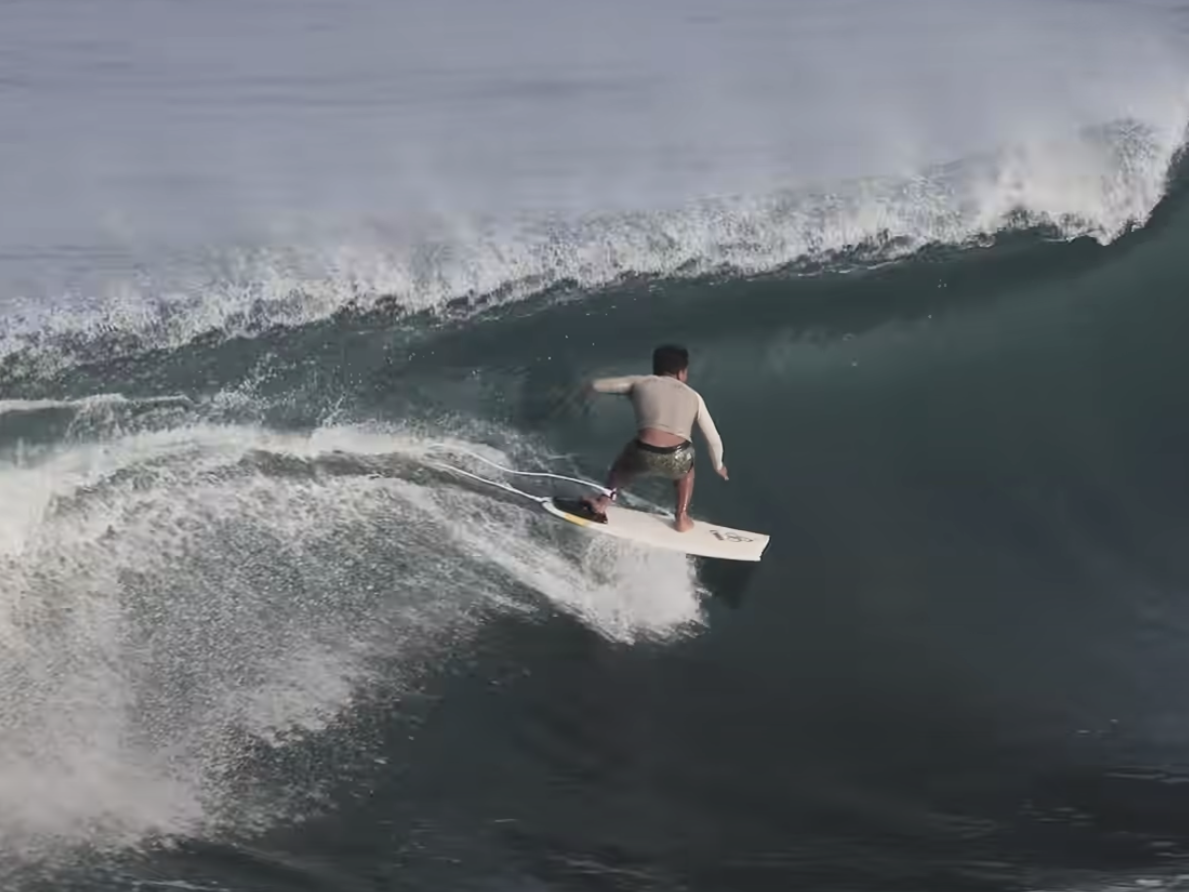
Good surfing in Uluwatu with split board
Local surfer Baim maneuvered, barreled and emerged with half a board under his feet


Good surfer makes any board ride
In this episode Eithan Osborne in a yellowish nineties, thin and with a pronounced rocker
